Buying
Water, power and internet: servicing land in Laos
Can you bring water, power and internet to a plot of land in Laos? Usually yes, but not always on the terms a foreign buyer assumes, and rarely at the seller's expense. Electricity now reaches almost every village, yet the line may stop several hundred metres from your boundary. Mains water is far from universal: even in Vientiane Capital, the state water supplier serves 378 of the capital's 481 villages, and the 103 still without piped water sit mostly in the very districts where foreigners look for space and value. Sewers, for most homes, do not exist at all. Before you pay for a plot, find out what is already connected, what it will cost to connect the rest, and who owns the pipes, poles and paths that bring it in. This guide sets out how to check each service, what to put in writing, and where the hidden costs sit.
Why is an unserviced plot rarely the bargain it looks?
The price of land in Laos is quoted per square metre, and the gap between a plot on a served lane and a plot two fields further out can look like an easy saving. It is often an illusion. The cheaper plot may need a new electricity line, a deep borehole, a water tank and pump, a septic system, a strengthened access track and, in the rainy season, drainage that holds. None of this appears in the asking price, and much of it cannot be priced until an engineer or the utility has looked at the ground.
Servicing also shapes what you can lawfully build. Our article on land classification explains that the category on the title decides whether a house may stand there at all. A plot that is correctly classified but has no road, no water and no power still has to be serviced before a builder can work on it, and before a bank, a tenant or a future buyer will take it seriously. Treat servicing as part of the purchase, not as a detail to sort out after the transfer.
This month gives the question a sharper edge. On 26 August, Vientiane's People's Council pressed the capital's water enterprise to speed up its expansion, after it reported that daily demand of about 504,000 cubic metres now runs some 104,000 cubic metres ahead of the roughly 400,000 it produces. Electricity, meanwhile, has become markedly more expensive: national price data for July showed electricity up 91.5 percent on a year earlier. A plot's running costs are no longer a footnote.
Is there mains water, and what if there is not?
In Vientiane Capital, piped water comes from the state water supply enterprise, and coverage stops at the edge of its network. By its own figures of late August 2026, it supplies about 79 percent of the capital, and the villages it does not reach are mainly in Pak Ngum and Sangthong districts and parts of Xaythany, the outer districts where land is larger and cheaper. Three projects, two new treatment plants and an expansion of an existing plant, are meant to add 80,000 cubic metres of daily capacity by the end of 2028, with the first due to be completed in April 2027. Plans of this kind tend to slip, so buy on the network that exists, not on the one announced.
Even inside the network, supply is not always steady. The enterprise itself cites seasonal swings in raw water levels, ageing pipes, water losses and power cuts. That is why so many Lao homes keep a ground or roof tank with an electric pump: the tank fills when the mains run, the pump keeps the pressure up when they do not. Budget for one even on a served street.
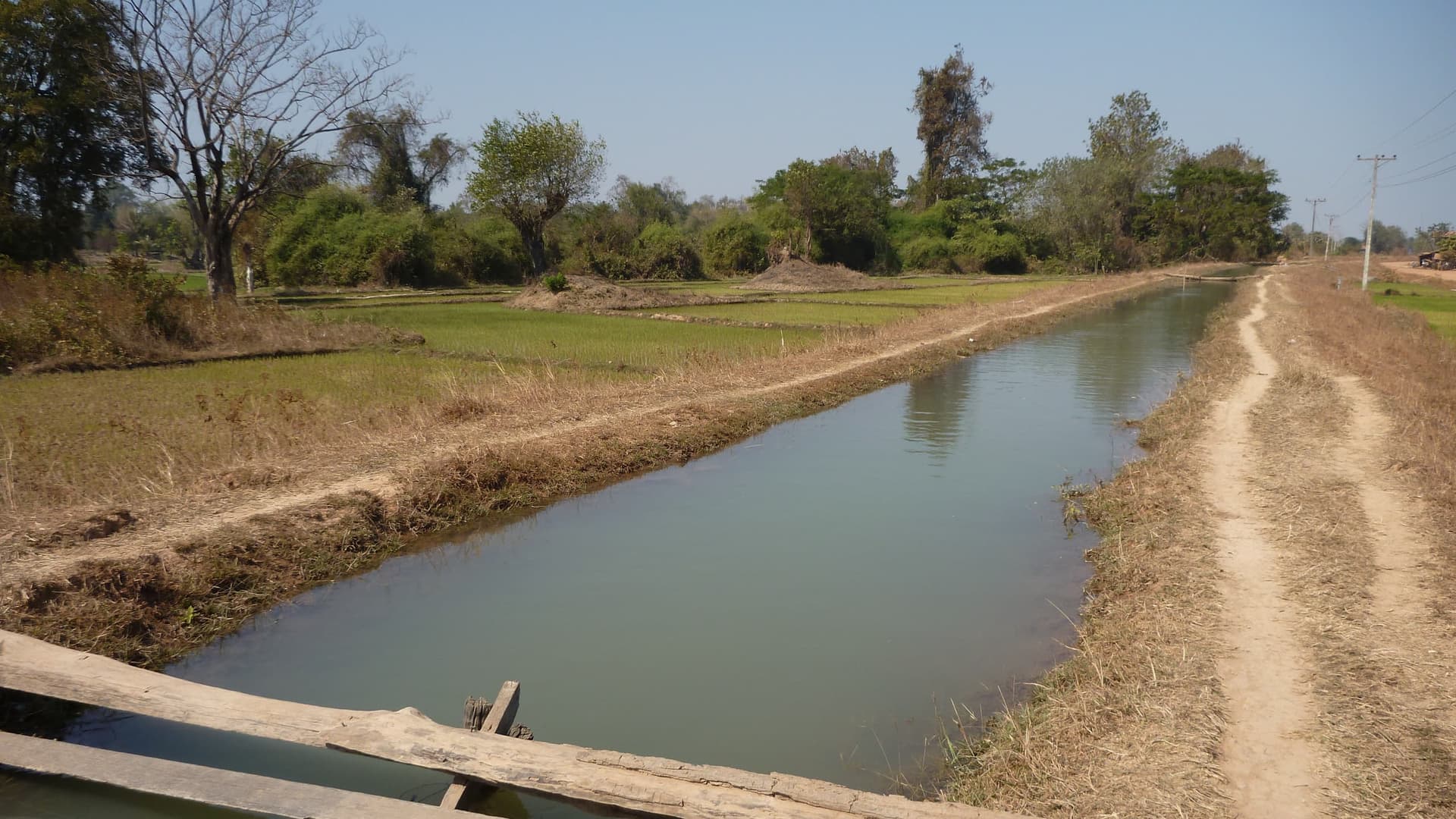
Outside the network, and in most of rural Laos, water comes from a well, a borehole or rainwater storage. A borehole can be a good answer, but its depth, yield and quality are unknown until it is drilled and tested. Groundwater in parts of the country carries iron or other minerals, and studies have found naturally occurring arsenic in some lowland areas, so commission a laboratory test before you rely on any well for drinking. Ask neighbours how deep their wells go and whether they run dry in the hot months before the rains. A plot beside a river or an irrigation canal does not have water rights merely by being close to it: the canal belongs to an irrigation scheme and the river to the nation.
How do you get a grid connection, and what will it cost to run?
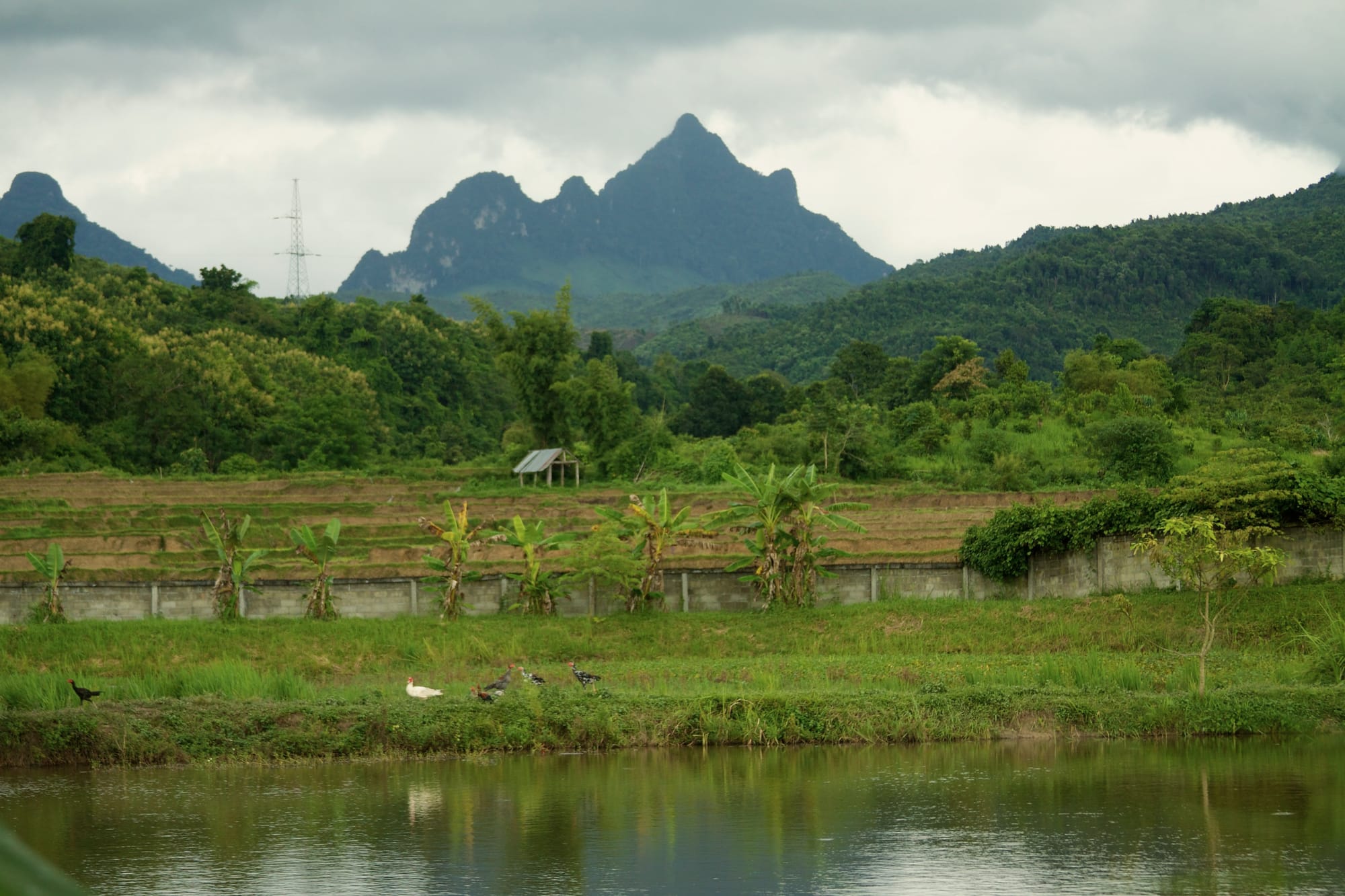
Electricity in Laos is distributed by the state utility, Électricité du Laos (EDL), which reported in August 2026 that it now serves some 1.86 million customers over more than 76,000 kilometres of lines. Most villages are on the grid. The practical questions are how far the nearest suitable line is from your boundary, and whether it can carry the load you have in mind.
A new connection is applied for at the local EDL office, usually with the land title or lease and the owner's identity documents. Where the low voltage line already runs along your lane, a connection is mostly a matter of a meter and a short cable. Where it does not, the line has to be extended with new poles, and a house with air conditioning, a pool pump or a workshop may need a three phase supply or its own transformer. Expect the cost of an extension to fall largely on the applicant, and ask EDL for a written estimate before you commit to the plot, not after.
Reliability matters as much as the connection. Laos exports a large share of the power it generates, yet parts of its own distribution network are old, and rural lines can fail when a single tree falls across them. EDL said at its mid year review in August that it would concentrate on improving supply and reducing outages for the rest of 2026. Until that work reaches your village, plan for interruptions: surge protection for electronics, a standby generator or a battery system for anything that must not stop, and a pump that restarts on its own.
Two further points. Running costs have risen sharply this year, so size air conditioning, pool equipment and water heating with the new tariffs in mind, and weigh solar panels or solar water heating, which make more sense now than they did a year ago. Speak to EDL before you connect any generating system to the grid. And under rules reported in July 2026, a home charger for an electric vehicle needs prior technical approval from the Ministry of Industry and Commerce, so if you plan one, include it in the electrical design from the start.
Where does the wastewater go?
For most homes in Laos, including most of Vientiane, there is no public sewer to connect to. Each house treats its own wastewater, usually with a septic tank and a soakaway, and the quality of that system is the owner's responsibility. On a plot you are buying, find out where the existing tank is, how old it is, when it was last emptied, and where the overflow goes. A tank that drains into a neighbour's land or a roadside ditch is a dispute waiting to happen.
On a new build, site the septic system well away from any well or borehole, on your plot and your neighbours', and size it for the household you actually expect, guests included. Ground that floods or stays waterlogged in the rainy season makes a soakaway fail, which is one more reason to read our article on flood risk before choosing a plot. Rainwater from roofs and paved areas needs somewhere to go too: in a heavy downpour, a new house that sheds water onto the lane will not make you popular in the village.
Can you work from there?
For many buyers the third utility is connectivity. Fixed fibre is available in Vientiane, Luang Prabang and most provincial towns, and mobile data covers much of the populated country. Coverage thins quickly in valleys, behind karst ridges and at the end of rural tracks, and an operator's coverage map is not a guarantee for a particular house.
Test it yourself before you buy. Stand on the plot, at the spot where the house would be, with SIM cards from more than one operator, and run a speed test at the hours you would actually work. Ask the nearest neighbours which service they use and how it holds up in storms. If fibre runs along the road, ask the operator whether it will connect your plot and at what cost. The government says it intends to expand telecommunications and internet access in remote areas, and the Cabinet listed it among its priorities in late August, but a plan is not a cable. Buy on the signal that exists today.
Who owns the pipes, poles and the path they cross?
A service line is only as secure as the right to run it. If water pipes, power cables or the access track cross a neighbour's land to reach yours, find out on what basis. In the countryside this often rests on an old understanding between families rather than on anything written, and it can be withdrawn when the neighbouring plot is sold or inherited.
Before you buy, walk the route of every line and of the road from the public way to your boundary. Where it crosses private land, ask for a written agreement with the neighbour, witnessed by the village chief, and have your lawyer advise on how it can be recorded. Check that the access track is a public road or a recorded right of way, not merely a path that everyone has used for years. A plot with no lawful access is very hard to service, to finance or to resell, whatever its view.
The same logic applies inside a lease. If you hold land on a long lease rather than outright, the lease should say who may install services, who pays for them, who owns the connections at the end of the term, and whether you may run lines across the landlord's remaining land.
What happens to the meters and unpaid bills when you buy?
Water and electricity accounts in Laos are tied to a meter and a named customer. When a property changes hands, the accounts do not move by themselves. Ask the seller for the latest bills, check with the utility that nothing is outstanding, and agree in the contract that the seller settles everything up to the handover date, with meter readings taken together on the day.
Unpaid bills are not a theoretical worry: Vientiane's council has explicitly told the water enterprise to recover arrears, and a cut supply is a poor welcome to a new home. After the transfer, put the accounts into your own name or your company's, as each utility allows (or, if you let the property, your tenant's), and keep the receipts. They are useful evidence of occupation, and a future buyer will ask for them.
What should you check, and put in writing, before you pay?
Servicing questions are easy to answer on site and expensive to discover after the transfer. Before you pay a deposit, work through the following:
- Water: is the plot on the mains network, at what pressure, and are there tanks and pumps? If not, the depth, yield and laboratory quality of an existing or test borehole.
- Power: the distance to the nearest suitable line, single or three phase, a written EDL estimate for any extension or transformer, and how often the village loses supply.
- Wastewater: the location, age and condition of any septic system, and where overflow and rainwater drain.
- Connectivity: fibre availability and measured mobile speeds on the plot, from more than one operator.
- Access: whether the road is public or a recorded right of way, and written agreements for any line crossing private land.
- Accounts: up to date bills, no arrears, meter readings at handover, and a clause making the seller responsible for anything owed before that date.
Then write the answers into the deal. A sale or lease contract can state which services are connected and working at handover, make the seller warrant that no utility debt is outstanding, and, where connection is not yet in place, set out who pays for it and what happens to the price if it proves impossible. A lawyer and an engineer will cost far less than a plot you cannot live on.
Done this way, servicing becomes what it should be: a known cost, priced into the offer, rather than a surprise that arrives with the first dry season.
This article is general information, not legal or technical advice. Utility procedures, tariffs and approvals in Laos change and vary by province, and the figures above are those reported in August 2026. Before you sign or pay, verify the position on your plot with the utilities concerned, a qualified engineer and a Lao-licensed law firm.