
Lifestyle
Moving to Laos: your furniture, your car and your pets
Can you bring your furniture, your car and your dog when you move into a home in Laos? Your furniture and your dog, yes, with the right papers. Your car, almost certainly not this year: since 1 June 2026 Laos has suspended imports of petrol and diesel cars until the end of December. Because the country has no coastline, a container reaches Vientiane by way of a Thai port and an overland journey in bond, and it is cleared by Lao customs at Thanaleng, beside the Friendship Bridge. Whether your household goods enter free of duty depends on your status and your documents, so get a written answer before anything is packed. A dog or a cat needs an import permit from the Department of Livestock and Fisheries before it travels. Plan the move around the house, not the other way round.
September is when many families arrive. The Lao school year opened in Vientiane on 31 August, and the question we hear most often once the keys are in hand is a practical one: how do we bring our life with us? The logistics have been in the news too. On 26 August the Ministry of Finance and the Ministry of Public Works and Transport met to iron out inconsistencies in the transit cargo fees charged at the Thanaleng Dry Port and in the tolls at the Friendship Bridge, the very route a household shipment from overseas usually takes. This guide walks through that route, the customs question, the car rule, pets, and the order in which to do things, so the move costs what it should and arrives when you need it.
How does a shipment from overseas actually reach Laos?
Laos is landlocked, so there is no Lao port to ship to. A container from Europe, Australia or the Americas normally lands at Laem Chabang, Thailand's main deep sea port, or at Bangkok, and continues overland under customs bond, by truck or by rail, to Nong Khai on the Thai bank of the Mekong. It then crosses the First Thai Lao Friendship Bridge, which road and rail traffic share, and is cleared at Thanaleng. International movers advise that the bill of lading should show Vientiane as the final destination, in transit through Thailand, so the goods are treated as passing through Thailand rather than imported there and then exported again.
Thanaleng is no longer a sleepy border post. The dry port beside the bridge now combines customs clearance, warehousing, container handling and the transfer between the metre gauge Thai line and the standard gauge Laos China Railway, and its operator reports around 2,000 vehicles entering or leaving each day. For a household moving from China, the railway itself is a second route into Vientiane. For a small consignment, a few boxes of books and papers, air freight into Wattay International Airport is simpler. For a family already living in Thailand, a truck across one of the Friendship Bridges is the usual answer.
Expect the door to door journey from another continent to take several weeks, longer around holidays and when paperwork is incomplete. The ministries' meeting on fees is a useful reminder that the charges along the way, Thai transit, the bridge, the dry port, can vary and change. Ask every mover for a quote that names each of them, rather than a single figure that stops at the Thai port.
Will you pay duty on your household goods?
This is the question with the least tidy answer, and it is worth being honest about it. The Lao Trade Portal, the official guide published for importers, states that personal effects are generally exempt from customs duty for foreigners taking up residence in Laos, as long as they are normal household items and not of a commercial nature, and it advises contacting customs when in doubt. International movers who clear shipments into Vientiane describe a stricter practice: duty free entry is reliably granted to diplomats and to staff of registered international organisations who hold an exemption letter from the Ministry of Foreign Affairs, while foreigners working for private companies, and those not employed in Laos at all, are often charged duty and see their cargo inspected.
Both accounts can be true at once. The exemption exists on paper, but whether you benefit from it turns on the documents you can show, your visa and stay permit, a work permit or a letter from a sponsor, proof of the home you are moving into, and on how the officer at the post reads them. Do not rely on the general rule. Ask a licensed customs broker, or the mover's agent in Vientiane, for a written view on your own case before you ship, and budget for the worst case: duty on the declared value of everything, with VAT added on top. Rates vary widely from one kind of item to another.
A few habits keep the bill down. Keep the inventory honest and itemised, with values and a note of what is used. Brand new goods still in their boxes look like stock for sale and are treated that way, so unpack and use new purchases before they travel. Keep receipts for anything of value. A declaration must be lodged within 15 days of the arrival documents reaching customs, and storage at the dry port is usually charged by the day, so a file that is ready before the container lands is the cheapest file. Do not expect leniency either: several Lao border checkpoints reported customs collections ahead of their annual targets by the end of July 2026.
Smaller imports follow the same logic. Shopping in Nong Khai or Udon Thani and bringing it back across the bridge is an import, not a loophole: a Ministry of Finance instruction allows customs to charge VAT on new personal goods worth more than 50 US dollars per traveller per crossing. Cash has its own rules, which we cover in our guide to bringing cash into Laos.
What is worth shipping, and what is better bought in Laos?
The climate decides more than taste does. The rainy season runs roughly from May to October, the air is humid for much of the year, and termites are a fact of life. Veneered chipboard swells, glue gives way, leather and fabric invite mould, and solid wood seasoned for a dry northern winter can split. Wooden crates and pallets usually need the heat treatment or fumigation mark of the international standard for wood packaging, and a good mover will handle it, but think twice before shipping large pieces of furniture that were never built for the tropics.
Electrical goods need the same scrutiny. Laos runs on 230 volts at 50 hertz, and sockets vary from house to house, so appliances built for 110 volt markets need transformers, and adapters are a fact of daily life. Large white goods are rarely worth the freight and the duty when the same brands are sold in Vientiane and across the river in Thailand.
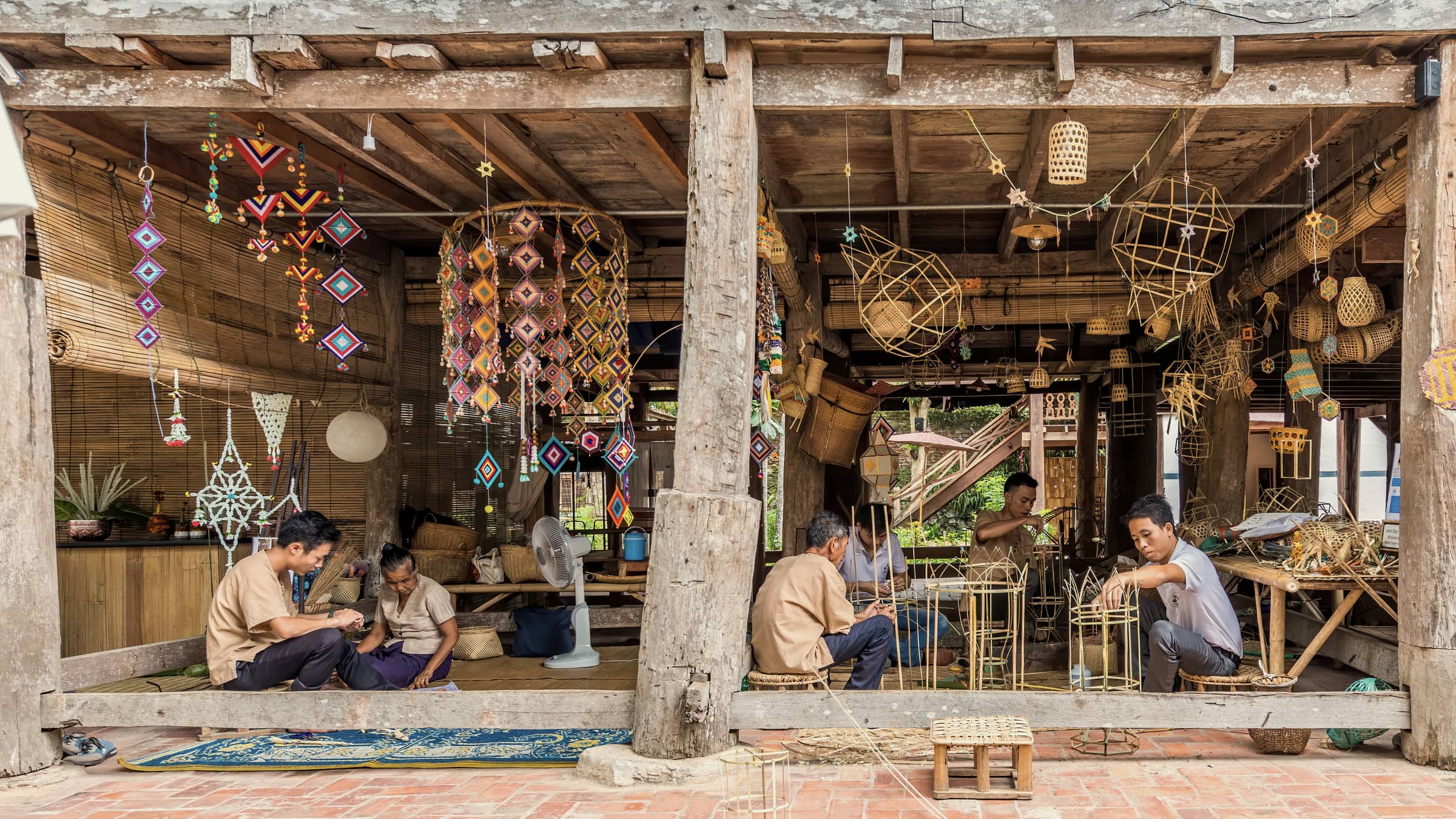
What Laos does offer is craft. Vientiane and Luang Prabang have skilled furniture makers, rattan and bamboo workshops, and the weaving tradition behind Lao silk, and a house furnished partly from local hands tends to suit its climate and its light better than a container of imports. The sensible rule is to ship what carries meaning or cannot be replaced, art, books, family pieces, a favourite chair, and to buy bulky ordinary things after you arrive, once you have lived in the house for a season and know what it needs.
Can you bring your car to Laos?
Not a petrol or diesel one, for now. Under a government notice of 12 May 2026, imports of petrol and diesel vehicles have been suspended from 1 June until 31 December 2026, to speed the shift to electric vehicles and cut fuel imports. The only exemptions are passenger transport vehicles, machinery, trucks serving specific production and development projects, and specialised professional vehicles. A family car is none of these. Whether the suspension will be extended into 2027 has not been announced, so treat a plan that depends on it lapsing as a gamble.
Even before this year's rule, shipping a car to Laos was rarely worthwhile. Movers report that second hand vehicle imports have long been restricted to diplomats and international organisations, an import permit has to be obtained before the vehicle arrives, and duties are assessed on type, age and engine size. Under the excise schedule, petrol and diesel cars carry excise of 25 to 90 percent depending on engine size, while the government has said that fully electric cars priced under 50,000 US dollars are to be exempt from excise altogether.
The practical answer is to buy in Laos: an electric car, which the government is actively encouraging, or a used petrol or diesel car from the local market. The same notice requires vehicle sales to be paid through the banking system, with proof of the bank transfer needed to register the car, so pay by transfer and keep the record. A Thai registered car can still be driven in for a visit under the temporary import regime, but it must leave again within the time allowed or a fine applies. It is a way to visit, not a way to keep a car in Laos.
How do you bring a dog or a cat?
Dogs and cats can come, but the paperwork starts before the flight is booked. The Lao Trade Portal lists them among the animals that need an import permit from the Department of Livestock and Fisheries, under a 2019 ministry decision on the movement of animals. The application is made with a copy of your passport and the animal's details, and once the file is complete the permit is issued within five working days. Apply at least two weeks ahead, longer if you can, because airlines generally will not board an animal bound for Laos without the permit in hand.
The animal also travels with its own file. Expect to need a veterinary health certificate issued shortly before departure and endorsed by the government veterinary authority of the country of origin, a rabies vaccination certificate, and an ISO microchip, which movers and airlines expect even where the rules are silent. Pet relocation agents commonly advise a rabies vaccination given at least a month and no more than a year before entry. Confirm the exact conditions written on your permit, because they are the ones that apply. At the border or the airport, a veterinary officer inspects the animal and its papers.
Once home, rabies is present in Laos, so keep boosters current, and ask a Vientiane vet early about ticks and heartworm, which thrive in the warmth. Heat is the other risk. Many airlines restrict short nosed breeds in the hottest months, and an animal landing in April deserves a cool, quiet first week indoors.

What should be settled before the container is sealed?
Most of the cost and delay in a move to Laos comes from a missing paper rather than from the distance. Six things deserve to be settled first:
- Your status: the visa and stay permit you will hold, and, if you work, the work permit or sponsor letter. Customs and the pet permit both lean on it. Our guide to living in Laos as a property owner explains the options.
- Your address: a signed lease or a registered title for the home, and the consent of the village authority where you will live, which foreign residents need before they settle in a village.
- Your inventory: an itemised list with values, used and new goods marked, serial numbers for electronics, and receipts for anything of value.
- A written duty opinion and a full quote: the broker's view on whether your goods enter free of duty, and a mover's quote that names Thai transit, bridge and dry port charges, clearance, delivery, and whether duties and taxes are included.
- Your animals' file: the import permit, the health certificate, the rabies certificate and the microchip record, all consistent with each other and with the flight.
- What stays behind: a petrol or diesel car this year, medicines without a prescription in your name, anything that needs a licence of its own, and anything in quantities that look like stock for sale.
In what order should you move?
Secure the house first, then your status, then the shipment. A container that arrives before you hold the keys sits in the dry port, and storage there is rarely free. Our guide to schools and healthcare makes the same point for families with children: the school place comes before the house, and the house before the furniture. A furnished rental for the first months gives you time to receive the shipment without pressure, and a few boxes sent by air bridge the gap.
Timing within the year matters too. Unpacking in the middle of the rainy season means moisture in every carton and delivery trucks on soft roads, and the narrow lanes of old Vientiane and Luang Prabang can call for a smaller truck and a second handling. Carry passports, deeds, contracts, jewellery and anything irreplaceable with you rather than in the container.
What does a move cost, and how do you keep it under control?
There is no honest single figure, because the cost depends on volume, origin and status. The lines to expect are the same in every quote: packing at origin, ocean freight, Thai transit and the bridge, dry port handling and storage, the broker's fee, duty and VAT if they apply, and delivery to the door. Insure the goods in transit separately, because a home insurance policy in Laos covers the house once you live in it, not the cargo on its way there. Our guide to insuring a property in Laos explains the difference.
Compare at least two movers that work with an established agent in Vientiane, read what the quote excludes, and pay invoices by bank transfer to the company's own account, never to an individual's. A move managed this way is not glamorous, but it is calm: fewer things shipped, each of them chosen, arriving in a house that is ready for them.
This article is general information, accurate to the best of our knowledge in September 2026, and is not legal, tax or customs advice. Customs practice, vehicle import rules and animal import conditions change, sometimes at short notice. Confirm your own case with a licensed customs broker, the Department of Livestock and Fisheries and a Lao-licensed law firm before you ship.